High mileage for a used car is not a fixed number. The Federal Highway Administration reports that the average American driver covers about 10,800 miles per year, which means a reliable benchmark for "normal" mileage is roughly 10,000–12,000 miles per year of vehicle age. A five-year-old car with 90,000 miles is above average; a ten-year-old car with 80,000 miles is not. But mileage only tells part of the story. The stronger predictor of whether a high-mileage car is worth buying is whether its odometer reading is consistent with its ownership history, title records, and maintenance documentation.
How Many Miles Is Too Much for a Used Car?
There is no automatic cutoff for mileage for a used model. Age gives the number on the odometer context, while average car mileage per year supplies a useful baseline. The search “what's high mileage for a used car” needs an age-based answer. A five-year-old car with 90,000 miles is above average. However, it could still be a reliable used car. A 12-year-old model with 45,000 miles may hide storage damage or missed service. Use these screening ranges before deciding:
- Under 60,000 miles. Often, the best mileage range for used cars when age and price fit.
- 60,000-100,000 miles. Normally acceptable with a complete service record.
- 100,000-150,000 miles. Inspect cooling, suspension, transmission, and timing components.
- 150,000-200,000 miles. Require strong service history and a repair reserve.
- Over 200,000 miles. Consider only when the car was maintained and priced for risk.
Average Annual Mileage in the United States
The Federal Highway Administration (FHWA) data for 2024 shows 10,812 miles per passenger car. 11,071 miles is reported across all vehicles. For shopping, 10,000-12,000 miles per year is a benchmark. Nonetheless, commute, climate, and car ownership length change the result. To learn how to calculate good mileage on a car, multiply the age by that range. Then, compare it with the records. High mileage is age-dependent.
FHWA reports an average of 10,812 miles traveled per passenger car in 2024.
Mileage Benchmarks by Vehicle Age
Age-based ranges make mileage easier to judge. The table uses 10,000-12,000 miles annually for different driving habits. An above-average mileage reading is not automatically a problem. An acceptable mileage level depends on the vehicle’s condition, records, and price.
|
Vehicle Age |
Expected Mileage Range |
Above-Average Mileage |
Buyer Recommendation |
|
1-3 years |
10,000-36,000 |
Over 40,000 |
Check rental, delivery, dealership loaner, or commercial use and warranty. |
|
4-5 years |
40,000-60,000 |
Over 70,000 |
Review tires, brakes, fluids, and scheduled work. |
|
6-8 years |
60,000-96,000 |
Over 105,000 |
Get an inspection and price the likely repairs. |
|
9-12 years |
90,000-144,000 |
Over 155,000 |
Demand consistent maintenance history and clear title records. |
|
13+ years |
130,000+ |
Over 180,000 |
Check corrosion, parts supply, and repair cost. |
Why 100,000 Miles Is No Longer a Universal Limit
Modern powertrains, corrosion protection, diagnostics, and fluids help vehicles built to last go beyond 100,000 miles. The old limit also ignores use: steady highway travel can cause less wear and tear than short city trips. A certified pre-owned or CPO car may include added checks, but the label does not replace records. Good mileage for a used purchase depends on design, upkeep, and history.
S&P Global Mobility states that the average U.S. vehicle age reached 12.8 years in 2025.
When Does Mileage Become a Real Risk Factor?
Mileage matters when it appears beside missing records or costly parts near replacement age. High miles also become a serious concern when the seller cannot explain how the car has been driven. The seller may also refuse an independent check. Mileage becomes a much stronger risk factor once a vehicle enters the range where major components commonly require replacement. For many vehicles, that means roughly 100,000–150,000 miles for cooling-system components, suspension parts, wheel bearings, and some timing-belt-driven engines.
Mileage Reporting Gaps
Mileage databases rely on events reported by states, repair facilities, insurers, auctions, and other sources. A gap does not prove fraud. However, it lowers confidence because high mileage may remain unrecorded. Use dates, owners, and mileage movements together. These common patterns call for different responses.
|
Reporting Pattern |
Possible Meaning |
Buyer Response |
|
Regular yearly entries |
Normal reporting |
Confirm the trend matches the condition |
|
Two-to-four-year gap |
Private service, storage, or missing data |
Request invoices and examine the car |
|
Reading stays unchanged |
Duplicate data, storage, or cluster change |
Compare the title and repair documents |
|
Sudden large increase |
Fleet, rental, delivery, or long commute |
Price the added wear into your offer |
|
Reading decreases |
Error, unit change, replacement cluster, or fraud |
Verify every dated entry before purchase |
Odometer Discrepancies and Fraud Indicators
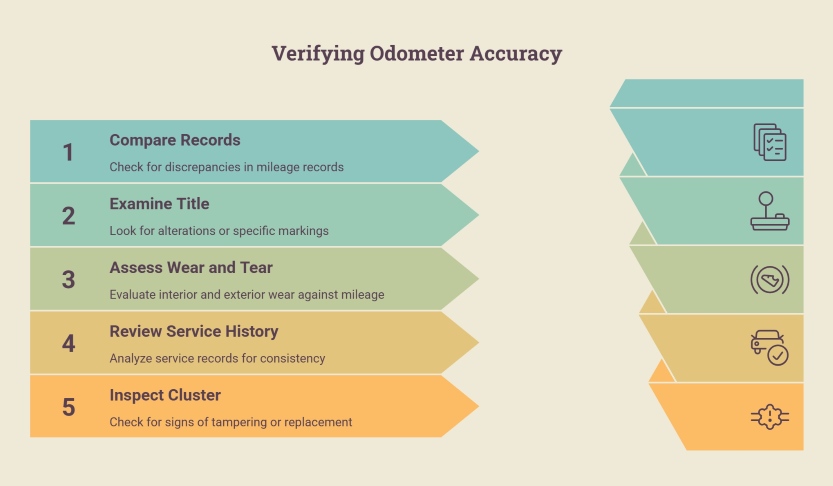
An odometer rollback can make a used vehicle appear newer and more valuable. Digital displays are vulnerable. Therefore, verify miles on the odometer. Compare the title, stickers, service record, tires, interior, and modules. Use this checklist before payment:
- A later record shows fewer miles than an earlier one.
- The title says “not actual,” “exceeds limits,” or has altered fields.
- Pedals, wheel, seat, or buttons conflict with claimed mileage.
- Oil-change stickers show a higher reading than the dashboard.
- The cluster looks replaced, loose, scratched, or wrong for the trim.
- Documents contain long gaps, duplicate dates, or unexplained transfers.
- Tire age and condition do not fit the stated use.
- The seller withholds the VIN or title.
The National Highway Traffic Safety Administration (NHTSA) estimates that more than 450,000 vehicles are sold yearly with false mileage readings.
High Mileage vs. Bad Vehicle History: Which Risk Matters More?
A clean, higher-mileage car can beat a low-mileage example with flood, salvage, theft, or crash records. High mileage affects price. However, title damage can hurt safety, insurance, financing, and resale. Regardless of mileage, compare the mechanical condition with the history. The table shows why history often matters more than high mileage.
|
Situation |
Mileage Risk |
History Risk |
Better Decision |
|
130,000 miles, clean title, complete records |
Moderate |
Low |
Consider after mechanical checks |
|
55,000 miles, rebuilt title, unclear repairs |
Low |
High |
Avoid without structural proof and a discount |
|
95,000 miles, minor claim, good records |
Moderate |
Low-moderate |
Verify repair quality and negotiate |
|
70,000 miles, flood brand or corrosion |
Low |
Very high |
Walk away |
|
160,000 highway miles, major services completed |
High |
Low |
Consider with a repair budget |
A VINGurus vehicle history report connects mileage, title brands, ownership, and auction information before a seller shapes your choice. Use it early, then share the findings with the mechanic to target damage and gaps.
The Mileage-to-Price Formula Every Buyer Should Calculate
Mileage is useful only when evaluated alongside the purchase price and expected repair costs. Begin with comparable used cars for sale by year, trim, drivetrain, and region. Adjust for mileage, title, condition, and repairs. Use this example to compare a car with higher mileage against a car with lower mileage:
- Local clean-history market price: $18,000.
- Excess mileage: 25,000 miles above similar listings.
- Mileage adjustment: $0.08 per excess mile, or $2,000.
- Immediate work: tires $800, brakes $600, fluids $400; total $1,800.
- Risk reserve for uncertain records: $1,000.
- Target price: $18,000 - $2,000 - $1,800 - $1,000 = $13,200.
- Final check: compare financing, insurance, and expected resale before accepting the savings.
When Paying More for Lower Mileage Makes Sense
Paying more for low mileage makes sense when two vehicles have clean histories, equal condition, and equally complete records. It is also rational when costly powertrain, air-suspension, battery, or emissions failures commonly appear near the higher reading. Use caution with a low-mileage vehicle that sat unused, missed time-based service, or wears old tires. Low indicators add value only when the car was stored properly and received all required time-based maintenance.
VINGurus Case Study: When Lower Mileage Was the Wrong Choice
A public VINGurus sample report shows why the lowest reading should not decide a purchase. Its history moved from 126,353 miles in June 2020 to 125,397 miles in September 2020. VINGurus flagged a possible rollback, so the latter figure was not a bargain. Dated evidence mattered more than the advertisement.
|
Review Point |
Report Finding |
Buying Impact |
|
Earlier reading |
126,353 miles in June 2020 |
Set a higher verified baseline. |
|
Later reading |
125,397 miles in September 2020 |
Created backward movement. |
|
Ownership |
Five recorded owners |
Required transfer review. |
|
Platform signal |
Possible rollback |
Made the apparent mileage advantage unreliable. |
Before choosing the lowest-mileage listing, use VINGurus to check whether history supports the dashboard. That check can prevent paying a premium for an unreliable number.
Mileage Thresholds by Vehicle Type and Reliability Profile

Vehicle type changes how high the mileage risk should be judged. Design, load, maintenance demands, and parts prices move the risk point. These ranges guide screening. They do not promise a lifespan. A good used example can last longer. Neglected high-mileage vehicles fail early.
|
Vehicle Type |
High Mileage Starts Around |
Typical Lifespan |
Common High-Mileage Risks |
|
Sedans |
120,000 |
180,000-250,000 miles |
Oil use, cooling leaks, suspension, transmission neglect |
|
SUVs |
120,000 |
180,000-250,000 miles |
AWD parts, bearings, suspension, cooling systems |
|
Pickup trucks |
150,000 |
200,000-300,000 miles |
Towing stress, differentials, transmissions, frame rust |
|
Luxury vehicles |
90,000 |
150,000-220,000 miles |
Air suspension, electronics, turbos, costly labor |
|
Hybrid vehicles |
120,000 |
180,000-250,000 miles |
Battery health, cooling fans, brake actuators, inverters |
How Many Miles Will the Car Have When You're Ready to Sell?
Before buying a used car, add your annual driving to its current reading. Then, multiply by planned ownership years. A 70,000-mile car driven 12,000 miles annually for five years reaches about 130,000 miles. This can affect demand and car value loss.
Check whether ownership will cross 100,000 or 150,000 miles. A car that still looks affordable today may face fewer buyers later.
High-Mileage Car Buying Checklist
Buying used vehicles with high mileage requires a repeatable process, not optimism. Verify identity, history, condition, and ownership cost before negotiating. Apply evidence rather than seller confidence. Follow these ten steps:
- Run the VIN decoder. Confirm year, engine, trim, and drivetrain.
- Order history data and compare each recorded reading by date.
- Match the VIN on the dashboard, door label, title, and documents.
- Review maintenance history. Check for regular oil changes, fluids, and transmission care.
- Inspect the vehicle cold for noise, smoke, leaks, and warnings.
- Arrange an inspection with a model-experienced mechanic.
- Check recalls, brands, theft, liens, and earlier auction photos.
- Price overdue work and common failures, then add a reserve.
- Test-drive in town and on the highway. Check shifting, braking, steering, heat, and vibration.
- Negotiate from verified costs. Leave if the seller blocks records or testing.
For high-mileage used cars, VINGurus organizes title, mileage, ownership, and auction clues. Use its results with a mechanic’s findings for a stronger used car buying decision.
Key Takeaways
- High mileage should be measured against age, use, design, and records.
- A used car’s mileage may be acceptable when its condition, price, maintenance history, and expected repair costs align.
- A reading that seems good for a used car still needs title and accident checks.
- Maintenance history and condition may outweigh the highest figure.
- Gaps, backward readings, and mismatched wear require investigation.
- A vehicle history report can help buyers identify potential costs before purchasing a used car.
Mileage is just one factor in determining value and reliability. It's not the only factor to consider or a reason to impose rigid mileage limits.
Frequently Asked Questions
Is There a Mileage Point Where Depreciation Slows Down?
Yes. Depreciation often slows after market thresholds such as 100,000 miles. However, several factors still influence value at resale. These are age, condition, demand, title status, and brand reputation.
Should I Invest in Major Repairs on a Car with Over 200,000 Miles?
Repair it when the frame, body, engine, and transmission remain sound. The total cost should be clearly lower than replacement with an available dependable alternative.
At What Mileage Do Cars Start Having Problems?
Issues can begin anytime. However, repairs usually increase significantly after 100,000 miles. Cooling, suspension, seals, sensors, and drivetrain parts reach later service stages.
Are Highway Miles Better Than City Miles on a Used Car?
Usually. Highway travel brings fewer cold starts, shifts, braking cycles, and pothole impacts. Nonetheless, maintenance, towing, climate, speed, and overall condition and driver behavior remain important.
Should I Buy a Car with a Rebuilt Title If the Mileage Is Low?
Only after structural and safety checks, insurer approval, and a steep discount. Low mileage cannot erase uncertain repairs, reduced resale, or later title-related financing issues.