
You can confirm whether your car is AWD or FWD in under a minute: check your build sheet or window sticker for drivetrain codes, run your VIN through a trusted decoder, and look underneath the car for a driveshaft and rear differential (AWD) or the absence of both (FWD). These three checks give the fastest and most reliable proof of your drivetrain.
What Do AWD and FWD Mean for Everyday Drivers?
All-wheel drive is a drivetrain that can route torque to both axles. Many crossovers use on-demand AWD. It engages only when sensors detect wheel slip. It can feel steadier on steep wet streets. However, it adds parts, service points, and can affect fuel economy. In everyday driving, it mainly helps you get moving smoothly, not stop faster. AWD offers added confidence for drivers who regularly face changing road conditions.
Here are the main features:
- The system can add extra traction (good for wet paint, gravel, or steep driveways).
- Types of all-wheel drive include full-time systems and clutch-based, sensor-controlled setups.
- AWD vehicles often feel calmer when traction changes suddenly.
- The pros and cons of AWD depend on tires, maintenance, and how often you face slippery conditions.
Drivers often report roughly a 5-10% reduction in fuel efficiency when all-wheel drive is added to the same model.

Front-wheel drive sends torque to the front axle. The front wheels pull while also steering. For commuting, the benefits of FWD are simplicity, predictable handling, and typically lower service costs. Many FWD vehicles also offer better packaging for a flatter floor and interior space. FWD models remain some of the most practical choices for urban drivers. For most daily miles, front-wheel drive is easy to live with and usually fuel-efficient.
The main features are as follows:
- Front-wheel drive keeps the weight over the front wheels.
- FWD systems are often lighter than AWD vehicles. This can improve fuel economy and help you save fuel.
- Many front-wheel drive vehicles return strong fuel efficiency in city traffic.
- With good tires, front-wheel drive cars stay calm and predictable in mixed weather.
Is It Possible to Confirm AWD or FWD With Your VIN?
Often, yes. A VIN decoder can show drivetrain details tied to the factory build. This includes the drive model and option codes. Because VIN rules vary by brand, treat the result as a strong indicator, not final proof. Confirm by looking underneath or checking an official build sheet before you rely on it for a purchase.
How to Tell by Looking Under the Car
Use a flashlight and look along the centerline. If you see a shaft going to the rear, the car likely routes torque to the back. If there’s no shaft, it’s usually front-wheel drive. For example, on an AWD Subaru Outback or Honda CR-V, you’ll clearly notice a round metal driveshaft running toward a rear differential housing, an easy visual giveaway. In contrast, a typical FWD Honda Civic or Toyota Corolla will show only the exhaust pipe and suspension arms, with an open space where a driveshaft would normally sit.
How to Identify a Rear Differential
On true all-wheel drive, you’ll usually find a rear differential centered between the rear wheels. It’s a metal housing with two axle shafts coming out on each side. Some compact designs hide it behind shields. Look for a bolted cover and a connected shaft, not just suspension links. If the back end is only springs and arms, it may be FWD.
Here is a flow to follow:
- Follow the shaft: it should connect to the rear differential housing.
- Look for two axle shafts: they run from the housing to the rear wheels.
- Check for a coupling: many systems use a clutch unit near the rear differential.
- Don’t confuse suspension parts: a torsion beam is not a differential.
How Your Car’s Traction Behavior Can Reveal Its Drivetrain
In a safe, open lot with loose gravel, ease into the throttle and watch for single-side spin. This can help determine the transmission type indirectly because traction control and clutch packs react differently. Tires and software can hide the result, so use them as support, not proof.
Common Mistakes When Checking Your Drivetrain
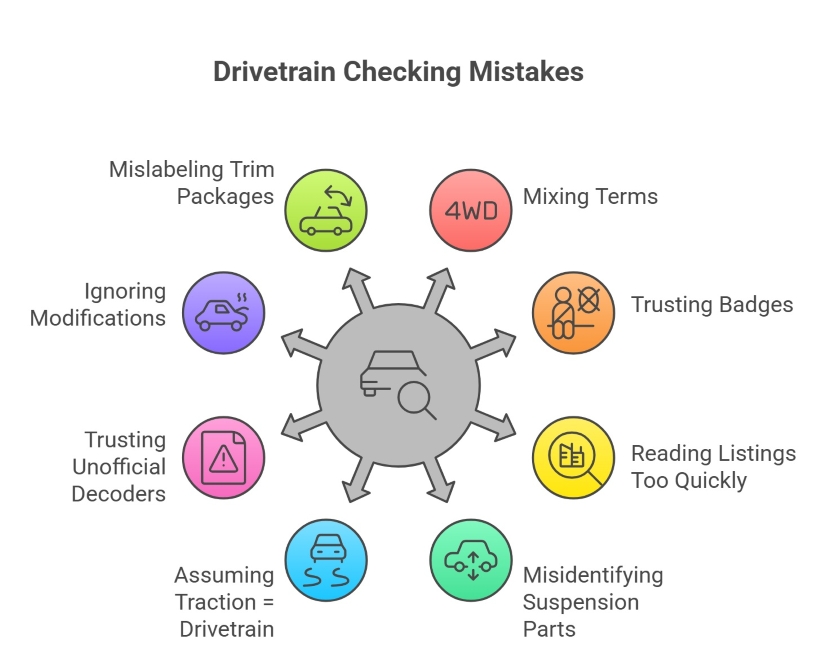
Most errors come from mixing terms, trusting badges, and reading listings too quickly. People also mix up all-wheel drive and four-wheel drive, even though they’re designed for different use cases, and vehicles tend to be marketed in ways that blur technical differences. Finally, lifted suspensions and swapped parts can hide what you’re looking at. This confusion is also why the Federal Trade Commission warns consumers about misleading vehicle listings and scams targeting private sellers online.
Use this checklist before deciding:
- Misreading VIN digits: a single wrong character can point to the wrong trim/drivetrain.
- Confusing 4WD with AWD: a 4WD system is often driver-selected. All-wheel drive is usually automatic.
- Misidentifying suspension parts: control arms and subframes are not shafts or differentials.
- Assuming traction = drivetrain: winter tires can make two wheels feel surprisingly capable.
- Trusting unofficial decoder sites: scraped data can miss mid-year changes and options.
- Ignoring signs of modifications: missing shafts or swapped components can change the setup.
- Mislabeling trim packages: the same trim can mean different drivetrains by year.
A Simple Way to Estimate Annual AWD vs FWD Ownership Costs
Ownership cost is more than gas. All-wheel drive adds couplers, seals, and additional fluids. Some owners see higher fuel consumption in city driving. You may face a higher purchase price on the used market, but the trade can be worth it, depending on hills, weather, and your routine. One advantage is easier pull-away on steep winter routes. This is often when AWD matters most.
What to estimate:
- Fuel: estimate your yearly miles. Compare expected fuel consumption and fuel economy between AWD and FWD trims.
- Fluids: budget for rear differential and coupling fluid service at the intervals your maker recommends.
- Tires: AWD is less tolerant of mismatched tread depth.
- Repairs: price common wear items (CV joints, couplers, or a wheel bearing) for your model. Spread the cost over your ownership years.
Drivetrain and Safety: When AWD Helps and When FWD Is Enough
AWD can help you move. However, it won’t shorten ice braking distance. Check vehicle recalls, tire condition, and brakes first. Then, choose the drivetrain that matches your roads. In everyday driving, this difference shows up most clearly when surfaces change suddenly. For instance, when pulling across a damp painted crosswalk or merging onto a gravel shoulder where an AWD Honda CR-V may feel more stable as all four wheels share the load. On winding uphill roads, an AWD crossover can maintain cleaner, steadier acceleration where a FWD sedan may tug slightly at the steering under throttle. Independent safety analyses have also shown that drivetrain type alone does not guarantee fewer crashes, reinforcing the idea that tires, speed, and driver behavior often matter more than AWD itself.
AWD vs FWD in Rain, Snow, Gravel
The real question isn’t “AWD better than FWD” in all cases. It’s about control and consistency. In the rain, hydroplaning is mostly determined by tread depth and speed. In snow, the key comparison becomes FWD vs AWD, especially on hills and in slush. On gravel, smooth steering matters more than peak torque, and cars also respond strongly to tire quality rather than drivetrain alone. Use the guide below for practical drive systems decisions.
|
Driving Scenario |
AWD Advantage |
FWD Advantage |
Key Determining Factor |
|
Uphill on packed snow |
Can send power to all four and keep a straighter wheel path |
Lower mass can feel easier to modulate |
Tires, slope, and throttle |
|
Ice at low speed |
Vehicles send power to the axle with grip through a clutch |
Pulls steadily and feels predictable |
Speed and smooth inputs |
|
Slush ruts |
Helps keep stability when the rear starts to drift |
Often improves fuel economy on wet commutes |
Tire condition and water depth |
|
Deep snow driveway |
Power to all four wheels helps maintain momentum |
Less drivetrain drag can help you “rock” gently |
Clearance, tires, and patience |
|
Gravel corner exit |
Can distribute power to reduce one-sided spin |
Clear understeer feedback is easy to read |
Throttle and stability control |
Many winter tire tests show roughly 20-30% shorter snow stopping distances versus typical all-season tires.
How Do Winter Tires Change the Equation?
Winter tires often matter more than the drivetrain. They provide better grip for acceleration, turning, and braking. Compared to FWD, AWD mostly helps with starts. It doesn’t change the basic physics of stopping. You can feel this right away: even a small FWD car becomes much more stable once proper winter tires are installed. The steering feels calmer, the car turns with less sliding, and you need less distance to slow down. Meanwhile, an AWD vehicle on worn all-season tires can still struggle in these same situations.
Signs Your Drivetrain Needs Attention
Drivetrains often give early hints before they fail. Clunks when shifting can point to mounts or a worn joint. A vibration that changes with speed can come from a failing hub bearing or shaft. Binding on tight turns can mean the coupling is fighting itself. Watch for leaks and warning lights that show the system stopped trying to send power.
Here are the warning signs:
- Clicking on turns near the nose: often a worn CV joint on front wheel drive cars.
- Thump on takeoff: can be a mount, joint, or rear differential bushing.
- Whine that rises with speed: may be bearings, gears, or low fluid.
- Shudder in tight parking turns: common on full-time AWD with mismatched tires.
- Flashing AWD light: the system may reduce coupling to protect itself.
What Uneven Tire Wear Can Tell You About Your Drivetrain
Uneven wear is usually due to alignment. Nonetheless, drivetrain drag can contribute. On AWD, a mismatched car tire size or tread depth can keep clutches slipping and overheating. On FWD, worn bushings can let the front tires scrub under torque. If one wheel position shows a sawtooth edge, check alignment and brakes before blaming the drivetrain.
How Mislabeling a Drivetrain Leads to Buyer Disputes
Mislabeling often starts with not knowing the difference between front wheel parts and the difference between front wheel drive layouts. Some buyers assume that an “AWD” badge means a traditional 4WD system. Others think every crossover has it. Verify what’s installed, because a missing shaft or swapped rear axle can turn an AWD listing into a FWD reality. A vehicle history report can help. However, it won’t always show a conversion.
Follow these steps:
- Match the build: confirm official option codes and drivetrain notes.
- Inspect underneath: look for a shaft and rear differential before paying.
- Check tires: mismatched tread depth can hide stress on AWD.
- Confirm trim rules: packages change by year, so verify your exact trim.
How Your Drivetrain Affects Reliability During Long Trips
Long highway miles heat fluids and expose vibrations. All-wheel drive adds more seals and rotating parts. Thus, small issues can grow into leaks if ignored. Some performance cars use aggressive torque management that stresses couplers if maintenance is skipped. For balance, rear-wheel-drive (RWD) cars send power to the rear axle. Vehicles behave differently by surface, and cars can also be modified, so verify before trusting a badge.
|
Long-Trip Concern |
AWD notes |
Front wheel drive notes |
|
Highway efficiency |
More drag can raise fuel consumption and reduce fuel efficiency |
Often more fuel-efficient overall |
|
Heat management |
Extra fluid points; service matters |
Fewer fluids and seals to monitor |
|
Tire strategy |
Replace sets; a mismatch can stress couplers |
Two-tire replacement is safer if wear is even |
|
Failure modes |
Couplers, shafts, and rear differential seals can wear |
CV joints and hub bearings are common |
Key Takeaways
- Fastest way to identify your drivetrain: check the VIN with a reliable decoder, then look underneath the car for a driveshaft and rear differential.
- Safety depends more on tires than drivetrain: AWD helps you get moving, while FWD stays predictable on most roads, neither shortens braking distance.
- Cost differences matter: AWD usually means higher maintenance and fuel use, while FWD is cheaper to own and easier to service.
- Pay attention to warning signs: uneven tire wear, traction lights, or odd noises can signal drivetrain issues that need inspection.
- Accuracy is important when selling a car: mislabeling AWD vs FWD can cause disputes. Always confirm with VIN + photos.
- Match drivetrain to your travel: AWD helps on hills, gravel, and mixed conditions. FWD works perfectly for highway and city driving.
- Use quick decision logic: check VIN before buying, prioritize winter tires in cold climates, and investigate traction problems early.
Frequently Asked Questions
How Does an AWD System Decide How Much Torque to Send to Each Axle?
Sensors monitor speed, steering angle, and throttle. The controller then uses a clutch pack to distribute power where grip exists and to manage front and rear torque flow smoothly.
Why Do AWD Cars Require Matching Tire Sizes More Strictly Than FWD Cars?
AWD expects a similar rolling diameter at each corner. If tires don’t match, the system constantly fights overheating clutches.
How Does AWD Help Maintain Stability When Climbing Steep Hills?
AWD can route power from the engine to the axle with traction. This reduces spin and helps the vehicle track straight on steep grades.
Can Modern Traction Control Make a FWD Car Feel Like AWD?
Traction control can brake a spinning tire and cut torque. Thus, a FWD vehicle can feel confident. However, it can’t create power for all four wheels. Deeper snow still favors AWD.
Why Does My AWD Light Flash on the Dashboard When Turning Sharply?
Tight turns create different tire speeds. The system briefly loosens the coupling to prevent binding. Low fluid, sensor faults, or mismatched tires can also trigger the light.