
Driving an unregistered car can lead to fines, towing, or higher insurance costs depending on your state, and officers can confirm your status in seconds through DMV records. To check your registration, use your state DMV’s online lookup with your plate number or VIN. This instantly shows whether your vehicle is active, expired, or suspended.
How to Check If Your Car Is Unregistered
Start with your car title and registration paperwork. Then, compare it to what your state system shows for the same plate and VIN. Look for expired registration, “inactive,” never registered, or a note that registration has lapsed. If your card and the system disagree, treat the automobile as an unregistered vehicle until you confirm an active record.
Use Your State's DMV Online Portal
Most states let vehicle owners verify registration in a DMV online portal fast. It’s the fastest way to see whether your vehicle registration is active, whether renewal is overdue, or whether a hold is blocking renewal. Tip: Use the exact owner name and address from your assigned title. Small differences can hide a match.
Have these basics ready:
- VIN and license plate number.
- Owner's name as printed on the title.
- Address currently on file.
- Insurance policy details.
- Payment method to register and extend registration.
Visually Inspect Plate Stickers, Tags & Documents
Online records help. However, if you drive, your plate and documents can reveal simple issues. Check the license plate for current registration stickers. Confirm the month and year match your card. Then, compare the VIN on the registration card to the VIN on the dashboard and door jamb. If something seems off, use a vehicle history report. It can hint at old plate swaps or title mistakes on a motor vehicle.
|
Item to check |
What looks correct |
What signals a problem |
|
Plate sticker |
Current month and year |
Sticker missing or wrong year |
|
Registration card |
Same name, VIN, plate |
VIN/plate mismatch |
|
Expiration date |
Not past due |
Registration has expired |
|
Address line |
Matches your ID |
Old address or typo |
|
Temp tag |
Valid dates shown |
Temporary tag expired |
The U.S. had 284,614,269 registered vehicles in 2023. Registration checks are routine for enforcement and insurers.
When Your DMV Records Don’t Match Your Documents
Mismatches happen after moves, purchases, lien updates, or delayed data entry at the Department of Motor Vehicles. To avoid issues, run a VIN decoder. It can confirm the make, model, and year match what you bought. If the portal says “inactive” but your card looks current, you may be driving without proof of registration in the system, even if you paid.
Take these steps so you protect your rights and get properly registered with the state:
- Compare the VIN on the title, dash, and door sticker.
- Confirm the plate number matches the card.
- Check whether registering the vehicle is still “processing.”
- Request a corrected printout.
- Store copies in the glovebox.
State-by-State Penalties for Driving Unregistered

Penalties for driving without registration vary by state. The same stop can mean a warning, a fine, or a tow. Knowing your local registration laws helps you drive legally. In stricter states, officers may issue immediate citations or initiate impoundment if your registration is expired, while others offer short grace periods before enforcing penalties. Some states also apply late fees or suspend your registration until insurance or emissions requirements are met.
Strict Enforcement States
In strict areas, officers treat driving without valid vehicle registration paperwork as a clear traffic offense. A first stop can bring a traffic citation, a fine, a penalty, and towing if the vehicle is missing updated tags or you can’t show documents. Many states label it as driving an unregistered vehicle. Some codes treat it as operating an unregistered vehicle. Repeat stops can add a bigger penalty and may lead to increased fees or license suspension. In extreme repeat cases, jail time is possible.
|
Strict pattern |
Example states |
Common first stop result |
What often comes next |
Authoritative source |
|
Zero tolerance |
New York (NY), Massachusetts (MA) |
Ticket + Tow risk |
Storage fees, court costs |
NY Vehicle & Traffic Law §401; Mass RMV |
|
Plate check zones |
Virginia (VA), Maryland (MD) |
Traffic citation likely |
Higher penalties for repeat offenses |
VA Code §46.2-613; MD MVA |
|
Repeat focus |
New Jersey (NJ), Pennsylvania (PA) |
Mandatory court appearance |
License suspension possible |
NJ Statutes 39:3-4; PA 75 §1301 |
|
Emissions-linked enforcement |
California (CA) |
Registration blocked after failed smog check |
Citation + renewal hold |
CA DMV / CA Health & Safety Code §44011 |
|
Insurance-linked suspension |
Texas (TX) |
Citation for expired registration tied to insurance lapse |
Registration suspension |
Lenient or Grace-Period States
Some states give a grace period after your sticker expires, and a common window is 15 days if you can show you renewed or started the process. Even there, you can still get a fine for driving with an expired registration if you can’t show the card. Many treat a first case as a non-moving violation or list it under administrative offenses. However, they still expect quick renewal. If you must drive, drive home and keep your receipt. States such as Texas, Colorado, and Oregon offer short grace periods when drivers can show proof of renewal, while Arizona and Washington often treat first-time expired registration stops as administrative issues rather than moving violations.
|
Lenient pattern |
Typical outcome |
What helps most |
|
Short grace |
Warning or a small fine |
Online receipt |
|
Mailing delay |
Reduced penalty |
Proof of payment date |
|
Officer discretion |
Varies by traffic laws |
Organized paperwork |
States With Unique Rules
Some states tie registration requirements to inspections, tickets, or local taxes, and it varies by location. In many counties, testing is required first, and renewal will not go through until you pass. Other places block renewal if you owe traffic tickets, even if your insurance is active. Some also issue temporary registration for short trips.
|
Unique rule |
Example state |
What it means |
Practical fix |
Authoritative source (exact statute/section) |
|
Inspection gate |
North Carolina (NC) |
Renewal is blocked until required safety/emissions inspection is passed |
Book testing early |
NC General Statutes § 20-183.4C — “Inspection required before registration renewal” |
|
Ticket hold |
Illinois (IL) |
Unpaid parking/traffic tickets can stop registration renewal |
Pay or dispute tickets first |
625 ILCS 5/3-405.1 — “Suspension of registration for unpaid fines” |
|
Tax hold |
Georgia (GA) |
Unpaid ad valorem/property tax blocks renewal |
Bring receipts or pay online |
O.C.G.A. § 48-5C-1 — “Title Ad Valorem Tax (TAVT) required before registration” |
According to VINGurus, about 29 states require an inspection to register a vehicle or extend an existing registration, often only in certain regions.
How Penalties Escalate for Repeat Offenses
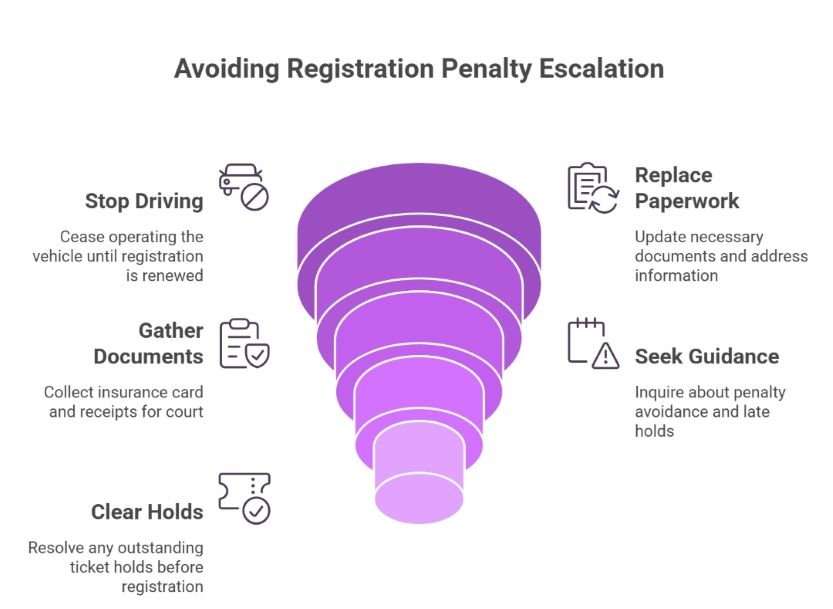
If you repeat a registration lapse, courts may assume you’re ignoring the rules, and your registration traffic history matters. Repeat stops can lead to fines and increased fines, and insurers may raise insurance premiums because the issue hits your driving record. When the lapse is tied to a lost car title, fix the title first so you can register again and minimize the potential cost. One way to avoid a bigger penalty is to register before you drive.
To keep this from snowballing, follow this plan:
- Stop driving until you extend your registration.
- Replace paperwork and update your address.
- Bring your insurance card and receipts to court.
- Ask how to avoid penalties and late holds.
- Clear ticket holds before you register.
What Happens If You Keep Driving Unregistered
If you keep driving with bad paperwork and drive anyway, stops become more likely, and each stop can add a new penalty. Over time, the consequences of driving this way usually cost far more than registration. In strict-enforcement states, repeated stops can lead to escalating fines and even temporary license suspension, especially if prior citations remain unresolved. Some jurisdictions also use automated license plate recognition, meaning your vehicle may be flagged without a traffic stop.
Can Police Impound Your Car on the Spot?
Many departments can tow for operating a vehicle without a valid card, especially if your expired registration is months old or you have prior traffic tickets. Rules vary by state, but officers often tow when they can’t confirm an active card at the roadside. If the car without papers is stopped, it may be treated as unlawful to leave it on the road.
What Officers Actually See During a Traffic Stop

During a stop, officers run your plate and VIN through state systems. They can see whether the record is active, whether the vehicle’s registration is suspended, and whether the plate belongs to a different vehicle record. They may also see theft notes, prior traffic tickets, and whether the system shows overdue tags.
Expect checks like these:
- Registration status and expiration date.
- Whether you’re driving without valid registration paperwork.
- Insurance match for the motor vehicle.
- Title or plate holds in the state system.
- Any suspension affecting driving privileges.
Will Insurance Drop You or Raise Your Rates?
Car insurance usually stays active during a short lapse, but repeated stops can still raise your premium. If you keep driving while out of compliance, some carriers may demand proof that your record is updated before renewal or reprice based on risk. Ask your insurer how a lapse affects auto insurance. For example, in states like Texas, insurers must report coverage lapses to the state’s insurance verification system, and repeated lapses often trigger “high-risk” reclassification.
How to Fix an Unregistered Status in Simple Steps
Fixing registration is straightforward if you follow an order and keep receipts. First, confirm what the online portal shows, then identify the cause so you don’t pay the wrong fees. If the record has a theft flag, clear it before anything else; the portal will note “car was stolen.” This is not legal advice; it’s a practical guide meant to support legal accuracy and remind drivers must follow traffic laws when operating a vehicle.
Use the checklist to register your vehicle again, so that valid registration may be restored quickly:
- Confirm registration status in DMV portal: Watch for notes like “vehicle was stolen”.
- Identify the reason for the lapse: Expired registration, hold, move, or title transfer.
- Check if your state requires emissions first: Inspection or emissions issues can block renewal.
- Pay fees, including any fine tied to registration.
- Extend online or schedule a DMV visit: Bring ID, title, proof of insurance.
- Save confirmation receipt: Print it and keep it with your documents.
- Check system sync within 24–72 hours: Verify the vehicle is registered.
Temporary Alternatives If You Can’t Renew Immediately
Sometimes you need to drive the vehicle, but you’re waiting on a document or appointment, or the vehicle but fail an inspection today. In permit states, a short trip permit lets you drive the vehicle for limited uses while you finish registration. In non-permit states, you should not drive without registration. Arrange a tow instead. These options can still create traffic tickets if you ignore limits, so read the permit carefully and keep it visible.
|
State category |
Permit duration |
Eligibility requirements |
Legal use cases |
|
Permit states |
1–30 days valid |
Insurance active, ID verified, fees started |
Commuting, inspection trips, restricted use |
|
Non-permit states |
Not offered |
Full renewal required first |
Tow only, off-road transport |
Summary
- Penalties vary sharply by state, and the same expired registration can mean a warning in one state or immediate towing in another. Always check your local rules before driving.
- The fastest way to confirm your status is through your state DMV portal using your plate number or VIN. It’s more reliable than stickers, receipts, or mailed notices.
- Do not rely on visual indicators alone. Stickers and mailed cards can be outdated or incorrect. The DMV database is the only source officers use during stops.
- Enforcement risks increase over time. Repeated lapses can lead to higher fines, ALPR camera hits, court appearances, or even license suspension in strict states.
- Fixing an unregistered status is usually straightforward: renew online if possible, resolve emissions or insurance holds, and confirm the update after the system syncs.
- If you can’t renew immediately, use legal alternatives such as a temporary operating permit (where available) so you can drive without risking towing or additional penalties.
- Prevent future issues by turning on renewal reminders, keeping your insurance active, and checking your DMV record once a year to catch errors early.
Frequently Asked Questions
Can Toll Systems Issue Fines Automatically for Driving an Unregistered Car?
Yes. Many toll systems read plates and match them to registration databases. Driving without registration can still result in fines by mail, even without a stop.
Does Driving with Dealer Plates Count as Being Legally Registered?
Dealer plates can allow limited driving a vehicle use, but they don’t always equal a current tag in your name. If the temporary tag has expired, it may be illegal to drive without proper registration.
How Does Failing an Emissions Test Affect Your Registration Status?
In inspection-gate areas, failing can block renewal, so your registration can lapse, and your renewal can’t be completed until repairs are done. Some states allow waivers. However, you still must meet renewal rules.
How Quickly Can I Fix an Unregistered Status If I Rely on My Car for Commuting?
If you can extend online, you can often fix it the same day. Keep a receipt that allows you to drive while the system updates. If you need a visit, schedule fast. Avoid driving while unregistered.
Can I Renew Registration If I Still Owe Parking Tickets?
Often, no. Unpaid tickets can block renewal. You may face penalties for driving without registration until the hold clears. Pay first, then renew.